The APEX Wealth Builder Framework
How genuine wealth gets built through a business. The outer game. The inner game. And what it takes to become an APEX Wealth Builder.
Most founders work incredibly hard and never reach the wealth they set out to build. Not because they lack talent. Because they don't know how to play the game.
This paper shows you the game. Both sides of it.
In this paper
- What an APEX Wealth Builder actually is
- Where most founders are (and why)
- The complex game: why building genuine wealth is harder than you think
- The inner game: the four layers of an extraordinary founder
- The outer game: the Wealth Builder Loop and the 10 dimensions
- Volume: why strategy alone isn't enough
- The compounding effect: why success breeds success
- Why everything matters more right now than at any point in living memory
What an APEX Wealth Builder Actually Is
Before anything else, here's the destination.
An APEX Wealth Builder has mastered three things. Each one is essential. Together, they compound into something extraordinary.
A — Asset-Rich. Your business and your life built as a living ecosystem of compounding assets. Every element optimised, connected, producing maximum yield with minimum dependency on you. An asset-rich founder doesn't trade time for money. They build things that produce value whether they're in the room or not. Asset-rich is the wealth builder mindset. It's the single most important shift that separates genuine wealth from a well-paid job.
P — Peak Personal Performance. The founder operating at their highest level. Not just skilled. Transformed. Past examined. Understanding how it shaped the beliefs you carry today. Identity rebuilt around who you need to become, not who you used to be. Principles consciously chosen. Patterns of behaviour aligned. The ability to perform at your peak when the stakes are highest. This is the inner game mastered. And it's what separates the founders who know the right move from the founders who actually make it.
EX — Extraordinary Life. The expanded life that comes from mastering both games. Financial freedom: wealth that doesn't depend on next month's revenue. Time freedom: days that belong to you. Agency freedom: the power to choose what you work on and who you work with. Location freedom: the ability to live and work wherever serves you best. But more than the four freedoms: an expanded world of opportunities, people, and experiences that continuously opens up as wealth compounds. The wealth and life you're dreaming of.
Asset-Rich. Peak Personal Performance. Extraordinary Life. Three concepts. Both games. One destination.
That's what this paper is about. How to get there. What most founders are missing. And why it requires mastering both the business and the founder at the same time.
Where Most Founders Are (And Why)
If you're being honest with yourself, this might sound familiar.
You built the business to create wealth and freedom. Instead, you've built yourself a job. A well-paid one, maybe. But a job. You're working harder than you ever imagined. The business depends on you for everything. Revenue is good but wealth isn't being created. You're not asset-rich, you're income-dependent. You're not at peak performance, you're exhausted. And the extraordinary life you imagined when you started feels further away than ever.
You're not alone. The vast majority of founders are in exactly this position. And here's the thing that should both concern you and give you hope: the founders who actually build genuine wealth are a tiny minority. Not the top 10%. Not even the top 1%. A fraction of a percent. The ones who cross from six figures to seven, and from seven to eight, and who do it while building a life they actually want to live.
Most founders never get there. Not because they lack talent. Not because they don't work hard enough. Because building genuine wealth through a business is a complex game, and most founders have never been shown the rules.
The Complex Game
Think of Monopoly.
Every individual roll of the dice is random. You have zero control over what you roll. But play a hundred games against a beginner and you'll win most of them. Not because you controlled the dice. Because you bought the orange set. You avoided the utilities. You built three houses before hotels. You made moves that shift the game slightly in your favour, every turn, every game. The dice were chance. The pattern across the dice was not.
Critically, Monopoly is specifically about wealth accumulation, not just winning individual moments. You can win individual rolls and still go bankrupt. You can lose individual rolls and still build an empire. The game is complex, and the way to win it is fundamentally different from what most people assume.
Business is the same game. Every specific deal, client, launch, or idea involves variables you can't fully control. But the pattern across many of them, over a long enough time, is absolutely something you can shift. You can't control the cards. You can control how many you're dealt, which table you're sitting at, and what you do with a good one when it arrives.
Most founders are playing Monopoly with free-throw thinking. They're optimising individual shots when the game is actually won by understanding the board, playing enough rounds, and knowing rules nobody ever taught them.
Getting to the top of the Wealth Builder Journey, from the first gold dot to the final black one, requires three things working together. Miss any one of them and you'll work incredibly hard and never get there. Master all three and you dramatically shift what's possible.
The right inner game. The identity, the principles, the patterns, the peak state to sustain the journey and make the right moves consistently. This comes first because without it, nothing else runs.
The right outer game. The ten dimensions of an APEX business, working together. The business structured to create genuine wealth, not just revenue.
Enough volume. The game requires more attempts than most founders realise. Volume is how you give the strategy enough opportunities to compound. Not grinding for the sake of grinding. Playing the game at the cadence it actually requires.
The rest of this paper shows you both games in detail, starting with the one most founders have never been shown.
The Inner Game: The Four Layers of an Extraordinary Founder
Here's the honest truth that separates this framework from everything else: the outer game can only run as well as the founder running it.
Every next level of business demands a next level version of the founder. The identity beliefs that got you here are the ones capping what you'll attempt next. The standards you hold are setting your ceiling. The patterns of behaviour that flow from both determine what you actually do every day. And the ability to perform at your peak when the stakes are highest determines whether you make the move or freeze.
Most advisory ignores this completely. Strategy people teach the outer game and assume the founder can execute it. The founder who has a brilliant strategy but freezes under pressure, self-sabotages at the critical moment, or can't sustain the volume the game requires, doesn't win. The founder with extraordinary inner game but no strategic framework doesn't win either. Both games have to run together.
The inner game has four layers.
Past
Every founder carries beliefs installed by their history. Some are useful. Many are quietly capping everything the founder is capable of. The work at this layer is confronting what the past installed and deciding which beliefs serve the future and which ones need to be replaced. This is not therapy. It's strategic. The founder who hasn't examined what the past put in place is being run by beliefs they never chose.
Present
The Present layer is where change happens. It has four elements, and the order matters.
Person. The identity you're operating as. Who do you believe you are when nobody's watching and the pressure is on? The founder who believes "I'm not a natural salesperson" will underperform on every sales conversation regardless of the script. The founder who believes "I'm not someone who builds a $10M business" will unconsciously sabotage every move that takes them toward it. These identity beliefs feel like facts. They're not. They're stories that became load-bearing walls.
Principles. The standards you hold yourself to. Not values on a wall. The actual bar you set for your performance, your business, your relationships, your ambition. Most founders have never consciously set their principles. They inherited them. And inherited principles usually cap you at the level of the person you inherited them from.
Patterns. The behaviours that flow from Person and Principles. How you respond to pressure. How you show up on a sales call. How you react when things go wrong. The crucial insight: try to change Patterns without changing Person and Principles, and they snap back within days. Change Person and Principles first. The Patterns follow naturally.
Peak. The trained ability to perform at your highest level on demand. Not waiting for motivation. Not hoping for a good day. State as a skill. The capacity to access your best thinking, clearest decision-making, and most powerful presence when the stakes are highest. This is trainable. The research confirms it. The founders who treat state as a skill consistently outperform those who leave it to chance.
Potential
The conviction that extraordinary outcomes are not just possible but available to you. Most founders operate with a ceiling they've never examined. The Potential layer is about shattering that ceiling and replacing it with genuine belief in what's achievable. Not manifestation. Not affirmations. Evidence-based, target-driven conviction that rewires how you see opportunity. You become wired to spot the right opportunities to get you where you want to be.
Purpose
The meaning that sustains the journey when everything in you wants to stop. Purpose is not motivational decoration. It is the pull that keeps you moving forward when everything in you wants to stop. The founder with clear purpose endures what the founder without it cannot.
The inner game is what separates the founders who see the right move from the founders who actually make it.
The Outer Game: How Wealth Actually Gets Built
The Wealth Builder Loop
The outer game runs on a loop. Four stages, running on a cycle. Two sides.
Search. Position yourself where the right opportunities can reach you. The founder with a diverse, well-bridged network, in the right rooms, across industries, encounters signals the specialist never hears about. Search isn't just active hunting. It's structural exposure. It's the Pluchino finding applied to business: luck finds people who have arranged themselves to be found.
Select. Of everything you're seeing, which opportunities are actually worth volume? Select is where raw signals get filtered into direction. The wealth-creating opportunities sit at the intersection of multiple signals at once, a macro shift plus an unmet need plus a friction point plus something proven elsewhere that nobody has transplanted. Most founders chase single-signal opportunities. The winners select for convergence.
Act. Once you know what to pursue, can you convert it into customers and keep them? This is where most of the effort of a business goes, and it's the stage most people reduce to "just hard work." In reality, Act is almost entirely governed by human psychology. Whether people want what you offer. Whether they trust you to deliver. Whether they believe they can achieve the outcome. Whether they feel they have to act now. And then, once they're in, whether the experience earns their long-term loyalty.
Assetise. What you do with the wins. Most founders consume every win as revenue and start again from scratch. The ones who compound turn every win into a structure that keeps generating. Methodology, community, authority, IP, systems. The business becomes a genuine wealth creation vehicle rather than a well-paid job. Assetise is what separates wealth from income.
The loop then runs again. Each turn, from a higher starting position than the last. That's how compounding actually happens.
The two sides of the loop
Search and Select together are what I call Discovery. Finding and choosing the right game to play. Act and Assetise together are Capitalisation. Winning the game once you're in it, and turning the wins into compounding structures.
This matters because the two halves are powered by different forces. Discovery gets driven by exposure to diverse networks, fresh thinking, and the honest pressure of same-level peers holding you accountable to the choices you make. Capitalisation gets driven by structured strategy, rigorous execution, and the discipline of turning opportunity into asset. Both matter. Both compound. And the businesses that run both sides properly pull away from everyone else.
That's the mechanism. The ten dimensions that follow are the operational map inside it.
The 10 Dimensions That Build an APEX Business
The APEX framework is the operational map of the Wealth Builder Loop. Ten specific dimensions, sitting across the four stages of the loop. Each stage contains the specific dimensions that determine whether the business runs that stage of the loop properly or not.
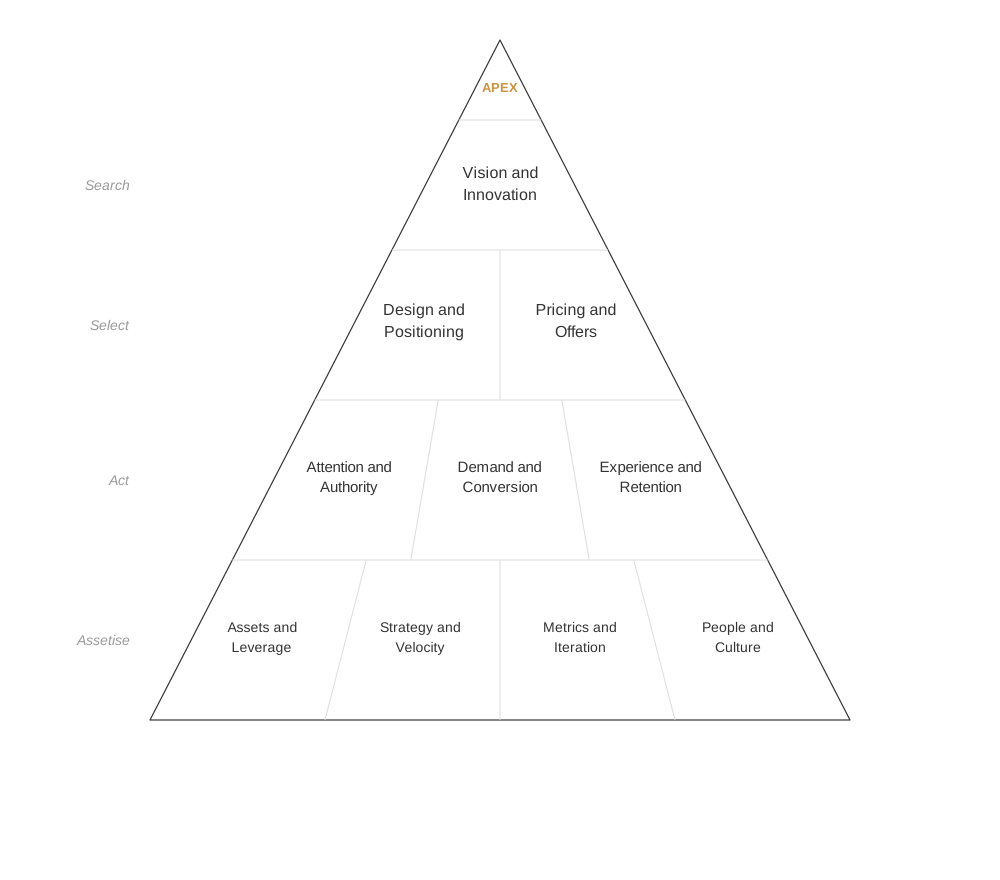
For each dimension, you'll see three things. What most businesses do by default. What the ones playing the wealth game do instead. And the specific thing that's changing in this era. Not tips. Paradigms.
Stage 1 · SearchWhere opportunity becomes visible. One dimension here, and it shapes everything else.
Vision and Innovation
Wealth games are won in directions most people can't see yet.
Most builders are running on a vision that was set years ago and has quietly become a reaction to the day. Strategy sits in a drawer. Innovation happens when someone has an idea. You're too deep in the business to see what's actually shifting outside it, and the world is changing faster than you can register.
Wealth-game players zoom out constantly. They carry one standing question. Where's the biggest opportunity, and what's in the way of it? Sometimes the answer is obvious and they act. Sometimes they have to look harder, and they're specifically watching for technology shifts that are past experimental but not yet obvious, deep unmet needs nothing is serving properly, industry frustrations everyone inside the category has learned to live with, and ideas from other industries that could transplant. The ceiling of the business is set by how far you're willing to look.
Where you choose what to build. Two dimensions: the position you design for, and the pricing architecture behind it.
Design and Positioning
Being comparable is the death sentence of the AI era.
Most businesses think positioning is their tagline. It isn't. Positioning is the deliberate shape of what you do, who you do it for, and what you stand against. In a world where AI makes any business look polished overnight, being clear and competent is no longer enough. Everyone looks good. The ones that win are the ones that can't be compared to anyone else.
Wealth-game players design their position rather than fall into one. They deliberately pick a stance competitors can't easily copy. They own a category rather than participate in one. They build trust and relationship with a specific audience that compounds over time. When that's right, three things change. The right clients find you. They arrive already trusting you. And price stops being the conversation.
Pricing and Offers
Most businesses are leaving 30 to 50 percent of their revenue on the table through pricing alone.
Not because prices are wrong. Because the offer architecture is. Most businesses have one or two offers, priced by looking at what competitors charge or what feels comfortable, and never revisited. Revenue scales by volume of work, not by value delivered, which means growth takes proportionally more effort, more people, and more strain.
Wealth-game players build a ladder. A sequence of offers that takes a client from their first small commitment through to their deepest engagement. Every step earns more trust and delivers more value. Pricing reflects the value of the outcome, not the hours behind it. And the counterintuitive part: premium pricing doesn't repel the right clients. It attracts them. The people paying more are easier to work with, get better results, stay longer, and refer more.
Where customers are won and kept. Three dimensions: attention, conversion, and the experience that holds them.
Attention and Authority
Authority is the one demand-side moat AI can't touch.
Most businesses treat marketing as a series of campaigns. Push content when you remember. Chase visibility in spurts. Nothing compounds. Because there's no genuine authority being built, the business stays comparable to every other business that looks like it, which means competing on price and chasing leads forever.
Wealth-game players build authority as a compounding system. Short-form content creates visibility. Long-form content earns trust. Podcasts, articles, talks, and books create the kind of authority that makes someone not just known but trusted as a real voice in their space. Every piece keeps working. And crucially, they run this at volume the market has never seen available to individuals.
Demand and Conversion
If you have to sell hard, something upstream is broken.
Most businesses treat selling as persuasion. The prospect arrives, the case gets made, objections get handled. Conversion rates are average because everything depends on individual skill rather than a designed journey. The founder is often the best or only salesperson, which caps everything at their capacity.
Wealth-game players design the buying journey. They know people don't buy because you convinced them. They buy when four things line up. They want the outcome. They trust you can deliver it. They believe they can pull it off. And they feel they have to act now. When all four are in place, the conversation doesn't feel like selling. It feels like the obvious next step of a decision that's already been forming. The journey is built to create each condition deliberately, not hope for them.
Experience and Retention
In a world getting more artificial, extraordinary human experience is the last real moat.
Most businesses think customer experience means fixing problems quickly and not messing up. That's the floor, not the ceiling. Almost all the energy goes into winning new customers, even though keeping one costs a fraction of the price. And the compound of retention, which is longer relationships, higher value, more referrals, is the single most underestimated lever in almost every business.
Wealth-game players treat experience as craft. Unreasonable hospitality. Thoughtfulness that's so specific and unexpected it changes how someone feels about the whole business. Safety in the relationship so the client can relax into it. Moments no competitor, algorithm, or AI could replicate.
Where wins get turned into structures that compound. Four dimensions: the assets themselves, the rhythm of running them, the discipline of measuring them, and the people who carry it forward.
Assets and Leverage
This is the dimension that separates wealth from income.
Most businesses create revenue through effort. People do work. Customers pay. Nothing gets built that produces value on its own. IP isn't documented. Processes live in people's heads. Content gets made and forgotten. Every pound of revenue costs roughly a pound of effort, which puts a hard cap on everything.
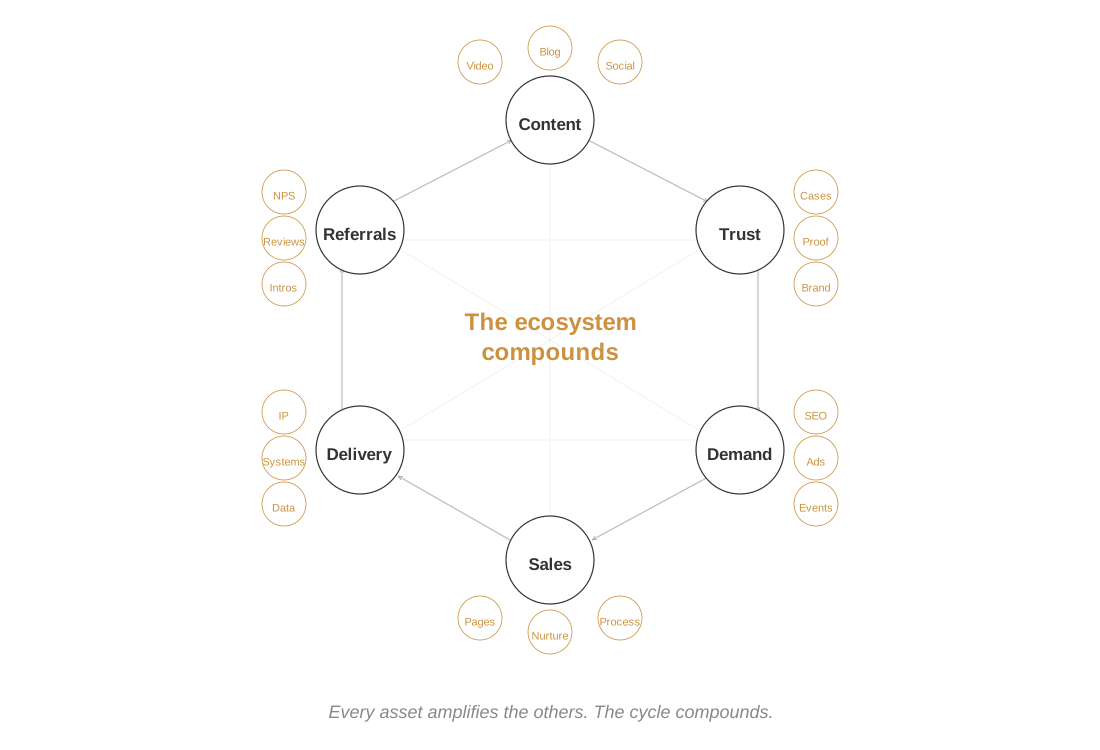
Wealth-game players see the whole business as a living ecosystem of assets. Every component (sales process, content library, delivery methodology, pricing architecture, client data, brand) mapped as an asset, measured, and deliberately connected to the others. Content builds trust, which drives demand, which feeds conversion, which produces results, which generates referrals, which feeds back into content. Every asset amplifies the others. The ecosystem compounds. And in the AI era, static assets aren't enough. Adaptive assetisation means creating them fast, connecting them fast, measuring them immediately, compounding the ones that work and cutting the ones that don't. AI only supercharges what's been structured. A business without a proper asset ecosystem is a blob with nothing for AI to grab hold of.
Strategy and Velocity
Why most founders work hard for years and end up nowhere near where they thought they'd be.
Most founders mistake busy for productive. The business is moving fast and things are getting done, but the things getting done aren't necessarily the things that matter. Real progress is moving deliberately along a chosen route, at deliberate speed.
Strategy is two things most founders blend into one. The first is where you're going, which is the work of vision. The second is the cleverest route to get there, which is the work of this dimension. The cleverest route is rarely the obvious one. The obvious route is the one competitors are taking. The cleverest route uses your specific strengths, captures the shifts happening in your market, and avoids the bottlenecks that swallow most of your industry's energy. Velocity is direction plus speed. Moving fast in the wrong direction takes you further from wealth, not closer. Wealth-builders maintain velocity through three nested cycles: quarterly sets the route, monthly surfaces what's slipping, weekly executes one clear priority. Each cycle feeds the next, and the business gets sharper with every revolution.
Metrics and Iteration
The fastest-growing businesses aren't guessing. They're iterating at speed.
Most businesses track revenue and maybe profit. They can't tell you acquisition cost, lifetime value, or unit economics by offer. They can't identify which products actually make money and which ones are being subsidised. Decisions happen on instinct. Which means the wrong ones get made all the time, and nobody finds out until much later.
Wealth-game players see the business through four layers at once. Strategic, are we executing our priorities. Financial, how is the P&L performing. Unit economics, what are each product's acquisition cost, lifetime value, and margin. Asset-level, how is each individual asset performing. They find the single biggest bottleneck and put everything on it until it moves. Then the next one. In the AI era, pattern recognition that used to take analysts weeks happens in minutes. The businesses that learn fastest pull away. Not because they work harder, but because they know where to focus.
People and Culture
The greatest advantage in the AI era isn't technology. It's people.
Most businesses have a team that grew by accident. Hiring happened when things got too busy. The founder is the culture. Leadership depth is thin, so if one or two key people left, the business would be in serious trouble. The whole thing depends on a small number of individuals holding everything together.
Wealth-game players know an A-player outperforms an average hire five to ten times and lifts everyone around them. They give every team member an AI co-pilot that amplifies their work rather than replaces them. Small teams of three or four people, each amplified by AI, are outperforming organisations ten times their size. But the technology only works if the people are right. AI in the hands of the wrong team just produces wrong outputs faster. The best talent can work anywhere in the world now. They gravitate toward businesses that offer autonomy, meaning, clarity, and genuine growth. Culture isn't a poster on the wall. It's how decisions actually get made.
The 10 dimensions at a glance
Score highly across all ten and you're building an APEX business. Score poorly in even one and it drags on everything else, often invisibly.
See around corners. Carry the question about where the biggest opportunity actually is.
Design a position that can't be copied. Own a category. Stop being comparable.
Build a ladder. Price for the outcome, not the hours. Decouple value from effort.
Compounding content. Authority as the one moat AI can't take.
Designed buying journey. Want, trust, can, must. Conversion as consequence.
Unreasonable hospitality. Retention as cumulative human care.
Living ecosystem of connected assets. Adaptive, not static.
Run the business on a beat. Quarterly, monthly, weekly cadence.
Four layers of measurement. Find the bottleneck. Shift it. Next.
A-players amplified by AI. Owner-independence as the output.
Volume: Why Strategy Alone Isn't Enough
You can have the best inner game and the best outer game in the world. Without enough volume, neither compounds.
Volume is the number of attempts you run. Conversations, ideas, content pieces, experiments, launches, iterations. The more attempts you take, in roughly the right direction, over enough time, the more the probability of breakthrough goes from small to almost inevitable.
Most founders run at a fraction of the volume required. They'll write ten pieces of content and wonder why nothing happened. They'll try two sales approaches and give up. They'll launch one offer and pivot if it doesn't land. None of that is enough for the strategy to do its work.
And here's what almost nobody has registered: volume itself used to be gated. Running lots of parallel experiments cost capital, teams, infrastructure. Most founders could only afford one serious bet at a time. AI has ended that. You can run ten experiments in the time it took to run one. For the first time in business history, volume is free to anyone who gets it.
The founders who understand this are running at a cadence the market has never seen available to individuals. The ones who don't are already being left behind.
But volume without the inner game is unsustainable. And volume without the outer game is noise. All three have to run together. That's the game.
The Compounding Effect: Why Success Breeds Success
Once a founder starts playing both games properly, at enough volume, something shifts. Success begins to compound.
Better opportunities find you. Better talent gravitates to you. Better deals present themselves. The more you win, the more you get the chance to win bigger. Each success creates the platform for the next one. Each new connection opens doors to connections you couldn't have reached before. Each asset you build amplifies every other asset.
This isn't luck. This is the earned compound of playing the game properly. It's what the founders at the top of the Wealth Builder Journey experience. And it's what the founders who never learn the rules never access.
The research supports this. Early advantages compound through social reinforcement. Founders who bridge diverse networks encounter opportunities others never see. Founders in the right rooms grow at more than twice the rate of those who build alone. The compounding effect is real, it's measurable, and it's available to anyone who plays the game properly.
Why Everything Matters More Right Now
AI is doing to business what mass production did to manufacturing and what the internet did to distribution. It's collapsing the cost of making things and reaching people toward zero. The businesses that have the right foundations, the structured assets, the ten dimensions running, the inner game sustaining it, are compounding at a pace that makes the last fifty years look gentle.
The businesses without those foundations are falling behind. Quietly. Steadily. Irreversibly.
The middle is disappearing. Wealth is concentrating at the extremes. The founders who understand both games and play them at volume are pulling ahead faster than at any point in living memory. The ones who don't are facing quiet, accelerating obsolescence.
This applies to every industry, every size. The plumbing company with twenty engineers. The logistics firm with a decade of route data. The professional services practice. Every one of them is about to meet a competitor who understood this earlier. Jeff Bezos is raising $100 billion specifically to buy traditional manufacturing businesses and deploy AI across every part of their operations. When someone with that track record is deploying that capital on this thesis, the direction isn't in question. The only question is who moves first.
The game is complex. The rules are learnable. The inner game is trainable. The compounding effect is real. And the window is closing.
Asset-Rich. Peak Personal Performance. Extraordinary Life. That's the destination. The outer game and the inner game, played at volume, is how you get there. That's what an APEX Wealth Builder understands.
How Much of Your Potential Are You Capturing?
Most businesses are operating at a fraction of the potential available to them. Not because the people running them aren't capable. Because when you're inside the business every day, it's almost impossible to see the full picture. The biggest opportunities and the biggest risks are nearly always invisible to the person running it.
There's a free diagnostic built on this framework. 50 questions across all 10 dimensions, taking around five minutes. The report shows where the business is genuinely strong, where the wealth upside is hiding, and what's most likely holding things back.
How close is your business to giving you the wealth and life you're dreaming of?
50 questions. 10 dimensions. 5 minutes. Free.
Get Your Wealth Builder Score ↗About Rokstrat
If this framework landed and you want to go beyond a self-assessment, that's what Rokstrat exists for.
Rokstrat is a strategic partnership programme for founders. Ryan Lamb works directly with a small number of founders as their ongoing strategic partner, working across all ten APEX dimensions and the inner game simultaneously. Alongside Ryan, every member gets Rok, a personalised AI advisory board trained on their specific business, and a room of extraordinary wealth builders on the same journey. If the thesis landed, explore what Rokstrat does at the link below.
Find out more about Rokstrat →